

Ecommerce website cost in India depends on how you pay for it. A developer-built site means a one-time build fee plus yearly hosting and upkeep. A subscription platform charges every month: Shopify Basic lists ₹1,994 a month paid monthly. A pay-per-sale platform takes a percentage only when you sell. Delivery charges are extra on all three.
Ask three people about a typical online store and you’ll get three answers that can’t be compared. Your nephew who builds websites quotes a one-time amount. A platform ad says you can start at no cost. A friend who sells online says she pays every month whether she sells or not. All three can be true at once, because each is describing a different way of paying.
What goes into ecommerce website cost in India?
This guide is for you if you already run a counter and want online orders without a nasty surprise six months in. Before you compare platforms, list every line that will eventually hit your account. Most “cost” articles only talk about the first one.
- The platform or software. A monthly or yearly fee, a fee per sale, or both.
- Hosting and security. Included on hosted platforms. A separate bill if a developer builds your site.
- Your domain name, if you want one. Optional on day one with many platforms.
- Payment processing. Charges for UPI and card payments, which may sit inside the platform fee or come as a separate payment gateway fee. Ask.
- Shipping. Almost never included in the platform price.
- Collecting cash at the door. Couriers usually charge extra for it.
- Returns and parcels that come back. The courier charge both ways is real money.
- Add-ons. Paid apps or plugins for GST invoicing, COD or courier labels, on platforms that don’t include them.
- Packing material. Boxes, tape, tissue, bubble wrap.
- Someone’s time. A few hours a week to add products, answer questions and pack.
Lines 5 to 10 exist whichever platform you choose. So the real comparison is mostly lines 1 to 4, plus line 8.
What are the three ways to pay for an online store?
1. A custom-built site
A developer or agency builds it, often on WordPress or similar, and custom development is billed by the job. You pay a one-time build cost, then hosting, domain, SSL and maintenance every year. It suits you if you need something unusual and have a person who’ll look after it. Watch for who fixes checkout when it breaks during Diwali, the yearly renewals, and the fact that payments and delivery still need setting up. Count the upfront build cost and the ongoing costs together for the first year, because that total cost is the number you’ll actually pay. Dukaan is another route, and the Dukaan alternatives guide compares what it charges.
2. A monthly subscription platform
You pay a fixed amount every month or year, sell or not. It suits you when online sales are steady and high enough that the fixed monthly cost is a small share. Watch for paying in slow months, features locked behind paid apps, and the transaction fee terms.
3. A pay-per-sale platform
There’s no fixed fee. You pay a percentage when you sell. It suits you when you’re testing, your sales are seasonal, or you’d rather your costs moved with your sales. Watch for high volume, where a percentage can overtake a flat fee, and check exactly what the percentage is charged on.
Quotes for custom-built sites swing so widely that any number we printed would mislead you. If you go that way, ask for the build price, the yearly hosting and maintenance price, and a written answer to “who do I call on a Sunday?”
What does Shopify cost in India? (checked 27 October 2026)
Shopify is the name most people compare against, so here are its published India prices, taken from the official Shopify India pricing page on 27 October 2026. If Shopify does not suit a shop with a counter, see these Shopify alternatives in India.
Basic is listed at ₹1,994 a month paid monthly, or ₹1,499 a month paid yearly. Grow is ₹7,447 a month paid monthly (₹5,599 paid yearly), and Advanced is ₹30,164 a month paid monthly (₹22,680 paid yearly).
Two details matter for a shop with a counter. First, the same page lists a fee for third-party payment providers used instead of Shopify Payments: 2% on Basic, 1% on Grow and 0.6% on Advanced. Second, its add-on for full in-store selling is listed at ₹7,000 a month per location, although every tier includes casual in-person selling at pop-ups and events. The page doesn’t say whether GST is added to these prices, so check at checkout. Prices change, so treat this as a snapshot, not a quote.
Shopify is a mature platform with a huge library of apps, and for many businesses it’s the right choice. Your question is simply whether its pricing model, and the storefront you’d build on it, fits the way your shop’s online sales are likely to grow.
What does Indi Andaz cost?
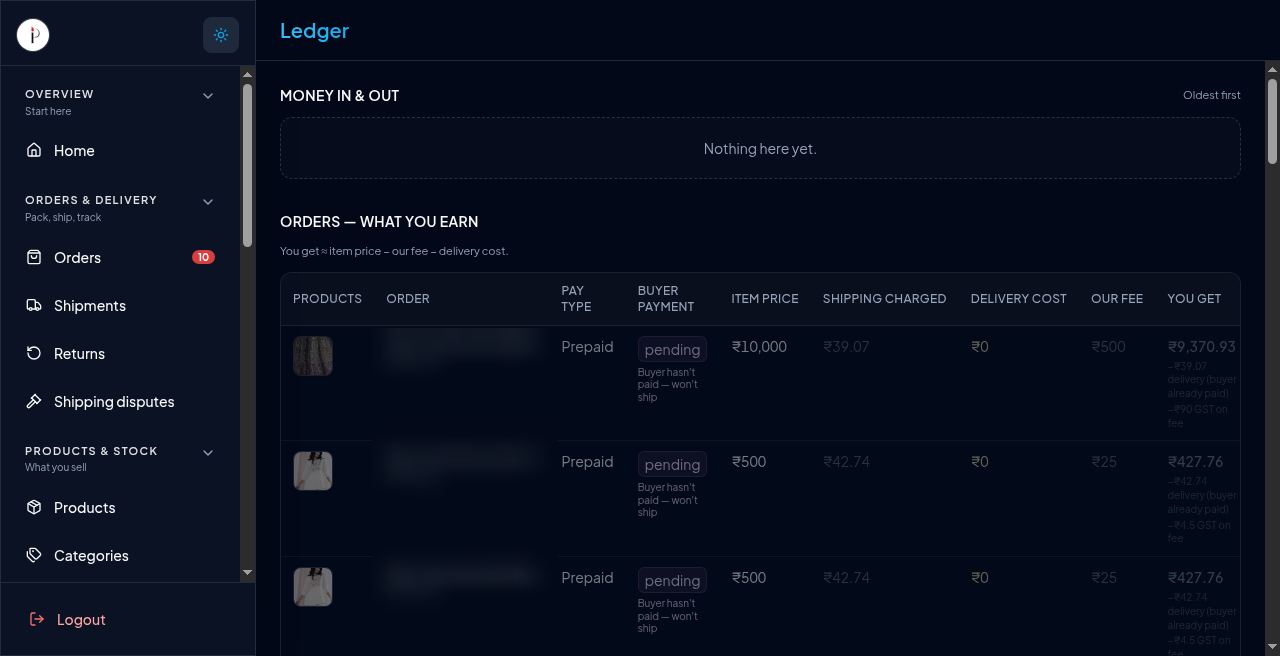
Indi Andaz pricing: no monthly fee, 5% only on delivered online orders, payment processing included. GST applies on the fee. Delhivery shipping is charged separately and isn’t part of the 5%. As an example, if a customer pays ₹1,000 for a product online, the platform fee is ₹50. Your ledger line then works out roughly as item price minus the platform fee minus delivery cost, then GST on the fee.
You also get the Counter app for billing walk-in customers, the web Seller Portal and the Android Partner app.
Monthly subscription or 5% per sale: what to compare
Put a quiet month and a busy month side by side for each option. On Indi Andaz: No monthly fee, 5% only on delivered online orders, payment processing included. GST applies on the fee. Shopify Basic is listed at ₹1,994 a month paid monthly, plus the payment fees below.
Prepaid orders add fees on the subscription side. Shopify Payments isn’t on Shopify’s list of supported countries for India, so you’d connect an outside payment gateway such as Razorpay, one of several Indian gateways, whose pricing page lists 2% per payment (checked 6 October 2026). On top of that, Shopify Basic adds its own 2% third-party fee on every order paid through an outside gateway. Shopify’s help centre says COD and other manual payments don’t attract that fee. On Indi Andaz, the 5% already includes payment processing, so you pay no separate gateway fee for UPI or card orders.
So the honest answer depends on how much you’ll sell online, and how evenly. A Varanasi saree house that sells ₹90,000 online in Diwali month and ₹8,000 in July has a very different year from a shop that sells ₹60,000 online every single month. Our guide to payment gateway charges in India breaks the prepaid side down further.
When is a monthly subscription the better deal?
Be straight with yourself here. A subscription platform usually makes more sense when:
- Your online sales are already steady and high, month after month.
- You need custom-coded themes or an unrestricted design editor.
- You sell internationally in several currencies.
- You run a dropshipping business. Indi Andaz is for sellers of their own physical goods, not a dropshipping supplier catalogue.
For a worked example across slow and festive months, read ecommerce platform commission vs monthly fee.
To be clear, Indi Andaz isn’t a Shopify clone: it doesn’t offer an unrestricted theme editor, and it is for sellers of their own physical goods, not a dropshipping supplier catalogue (see how Indi Andaz works).
When does paying per sale make more sense?
The per-sale model tends to suit an established shop when:
- You’re testing online and don’t know yet what it’ll bring.
- Your online orders bunch up around festivals and weddings, with quiet months in between.
- You also need GST billing at the counter in the same account. On Indi Andaz, the Counter app for GST billing handles barcodes and cash, UPI, card, udhar or split payments. Counter stock and online stock are kept separate today.
- You’d rather pay nothing in a month when the whole family is at the counter and nobody’s touched the online store.
What’s the catch with stores that advertise no cost?
Sometimes there isn’t much of one, within limits. When an ad says you pay nothing, look for four things: a cap on products or orders, a fee per sale, charges for payment processing, and features such as your own domain or COD that sit behind a paid tier. None of that is dishonest. It’s how the business works. Read the pricing page, not the ad.
Indi Andaz doesn’t claim to cost nothing. There’s no monthly fee, and the 5% on delivered online orders is how it earns.
What hidden costs should you budget for on any platform?
Delivery. On Indi Andaz you can let the buyer pay for delivery at checkout, or choose to cover delivery yourself on chosen products and bear that cost. Selling on marketplaces instead? Compare Amazon, Flipkart and Meesho seller fees on the same kurta.
COD handling. Couriers charge for collecting cash. On Indi Andaz, delivery is charged separately and is not part of the 5%.
Parcels that come back. A refused COD parcel costs you the courier charge both ways. Clear photos, honest descriptions and a confirmation call on bigger orders help.
A domain, if you want one. On Indi Andaz you can start on indiandaz.com/sellers/yourshopname and connect a domain you own later.
Time. For most shops the biggest cost isn’t money. Give the online side a person and a fixed slot in the week.
Questions to ask any platform before you sign up
- Is there a fixed monthly or yearly fee, and does it include GST?
- Is there a fee per order, and is it on product price only or on delivery too?
- Are payment processing charges included, or separate?
- Do I need paid apps for COD, GST invoices or courier labels?
- Can I bill walk-in customers at the counter, and does that cost extra?
- When and how do payouts reach my bank?
- Can I use my own domain, and what happens if I leave?
Write the answers down side by side. The headline price on a banner is often not what you pay in your ledger.
If you’re still deciding whether you even need a website, read our guide to an online store without a website. When you’re ready, you can set up your store link on Indi Andaz.
FAQ
How much does an ecommerce website cost in India?
It depends on the model. A developer-built site has a build fee plus hosting and maintenance. Monthly platforms charge a fixed amount, for example Shopify Basic at ₹1,994 a month paid monthly on its India pricing page as of 27 October 2026. Pay-per-sale platforms such as Indi Andaz charge no monthly fee and take 5% on delivered online orders. Delivery is extra in all cases.
Is there an ecommerce platform with no monthly fee?
Yes. Indi Andaz: no monthly fee, 5% only on delivered online orders, payment processing included. GST applies on the fee, and Delhivery shipping is charged separately.
Does Shopify charge transaction fees?
Its India pricing page lists a third-party provider fee of 2% on Basic when you use an outside gateway, on top of payment gateway fees of about 2% for the gateway itself. Shopify’s help centre says COD and other manual payments don’t attract that fee.
Are ecommerce shipping charges included in the 5%?
No. The 5% is on product price. Delivery is charged separately and is not part of the 5%.
Is a domain part of the ecommerce website cost?
Not on day one. On Indi Andaz your store starts at indiandaz.com/sellers/yourshopname, and you can connect a domain you own later.
What does an ecommerce website cost for a shop with a counter?
On Indi Andaz the online side costs 5% only on delivered online orders, and the Counter app handles GST billing at the shop from the same account. Counter stock and online stock are kept separate today.
New here? Start with our Start here page.
Sources: Shopify India pricing page, shopify.com/in/pricing (last checked 27 Oct 2026); Razorpay pricing page (checked 6 October 2026); Shopify Help Center on third party payment providers. Prices change; treat these as a snapshot.


Leave a Reply