
Can you run an online store without website building or a developer? Yes. You need far less than most shop owners think: clear photos, honest prices, a store link customers can open from Instagram or WhatsApp, a checkout that takes UPI, card and COD, and a way to ship. Here’s what that takes in practice.
Take your handloom saree shop in Bhubaneswar. (A typical example, not a real shop.) You’ve wanted an online store for two years. A cousin who “does websites” quoted a price, took some pictures, then got busy with his job. The half-built site still shows a sample product called “Lorem ipsum”.
Last winter you tried a website builder yourself. You watched videos in the evening after pulling down the shutter. You chose a theme, got stuck on shipping settings, then on connecting a payment gateway, and finally on why the product images looked stretched on phones. After three weekends you gave up. Back to WhatsApp.
You’re not bad with technology. You run UPI, a billing app and an Instagram page. You just don’t have time to learn a second profession. Who does?
Why does building a website feel like a second job?
Because it has six moving parts, and each one wants a decision from you.
- Domain and hosting: which name, which company, what renewal price in year two.
- Theme and design: how it looks on a ₹10,000 mobile, where the menu goes.
- Product pages: photos, descriptions, sizes, prices.
- Checkout and payments: usually a separate payment gateway, with its own KYC and fees.
- Shipping: courier accounts, 500 g weight slabs, pincodes, labels.
- Updates: someone has to change prices, remove sold-out items and fix things when they break.
A developer can build all this, but the build is only the start. You still have to run it every day. When they move on, some shops are left with a website nobody can update. It happens a lot.
What does the website builder route cost?
Website builders solve some of this, but they cost money and time of their own. If you want a builder, see these Shopify alternatives in India for shops.
As one example, Shopify’s India pricing page (checked 6 October 2026) lists Basic at ₹1,994 a month paid monthly, or ₹1,499 a month paid yearly, after an introductory offer. The same page says third-party transaction fees may apply if you use a third-party payment provider instead of Shopify Payments (Shopify India pricing). Our guide to ecommerce website cost in India sets those numbers against a per-sale fee.
Then there’s the learning curve. A 2024 study by LEAD at Krea University and nasscom foundation, covering 792 rural women entrepreneurs, found that 52.3% said managing online sales was difficult. An expert quoted in the same report pointed to limited internet access, photography skills and logistics as real obstacles for small sellers: IFMR LEAD study on social commerce (September 2024).
That study is about rural, women-led micro businesses, so it isn’t a picture of every shop. But the hurdles it lists are the ones most first-time online sellers hit. Dukaan is another builder, and the Dukaan alternatives guide covers what it costs.
Online store without website: what do you actually need?
Strip it down and a small business needs surprisingly little on day one to start selling:
- Products with clear photos, a price and a short description.
- A link customers can open from Instagram, WhatsApp, a QR code on your counter or a visiting card.
- A checkout that accepts UPI, card and cash on delivery.
- The customer’s address, typed by the customer, not copied by you.
- Shipping without haggling with courier companies yourself.
- One list that shows who has paid and who hasn’t.
- A clear fee, charged only on orders that are delivered.
A custom domain, a blog, fancy banners? Nice later. You don’t need any of it to take your first online order.
How do you take product photos that sell, with just a phone?
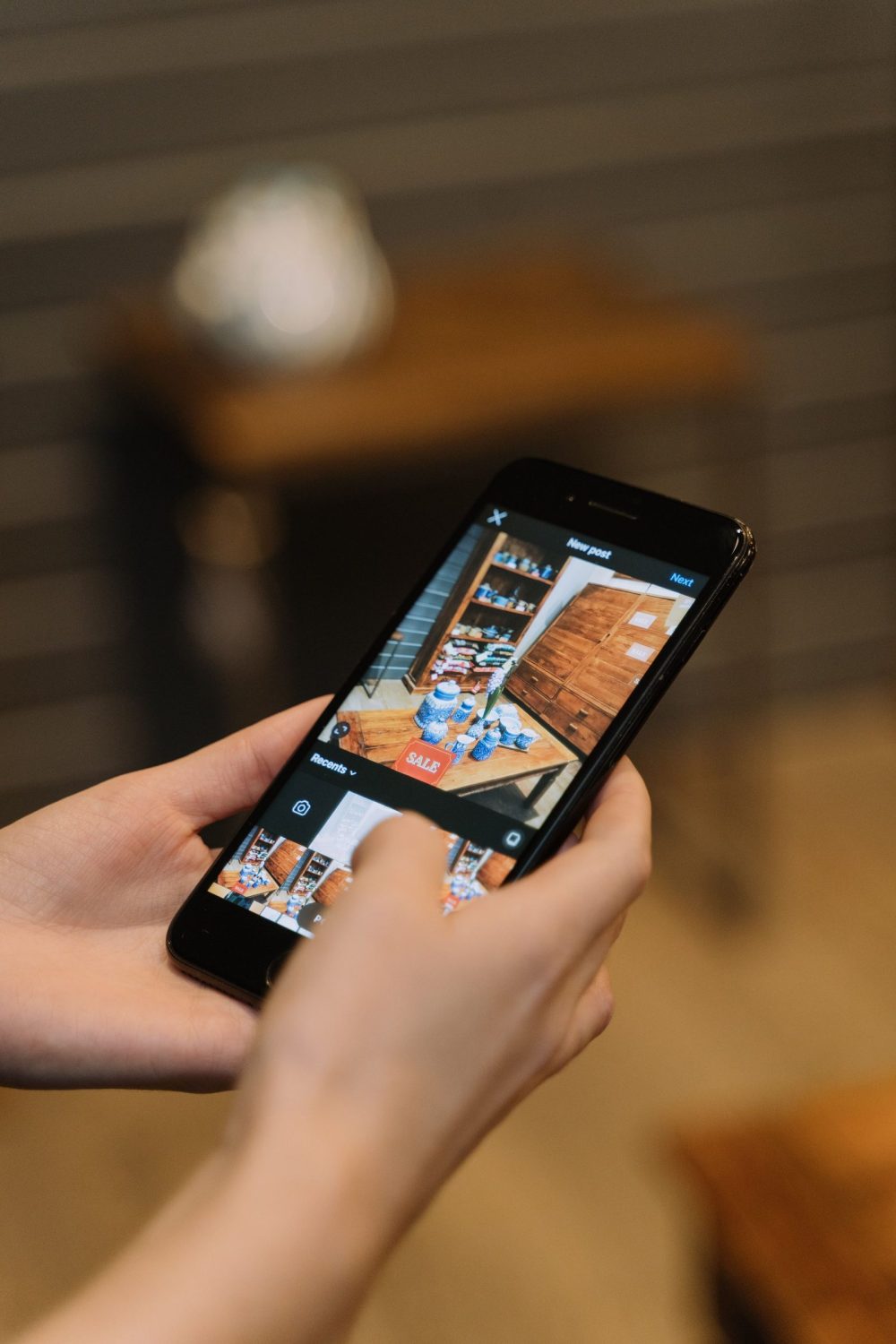
No platform can do this part for you, so it’s worth getting right.
- Use daylight. Shoot near the shop door or a window between 9 and 11 am. Switch off the tube lights so the colours don’t mix.
- Keep the background plain. A white wall, a clean bedsheet or a plain board works.
- Show the detail. For a Sambalpuri or Kanjeevaram saree, add one close-up of the weave or border. For jewellery, one photo on a hand or neck for scale.
- Keep the same angle for similar items, so your store looks neat.
- Write descriptions the way you talk at the counter: fabric, size, care, and what occasion it suits.
An online store with honest, clear pictures will beat a fancy website with dull ones. Every time.
How does setup work with Indi Andaz?
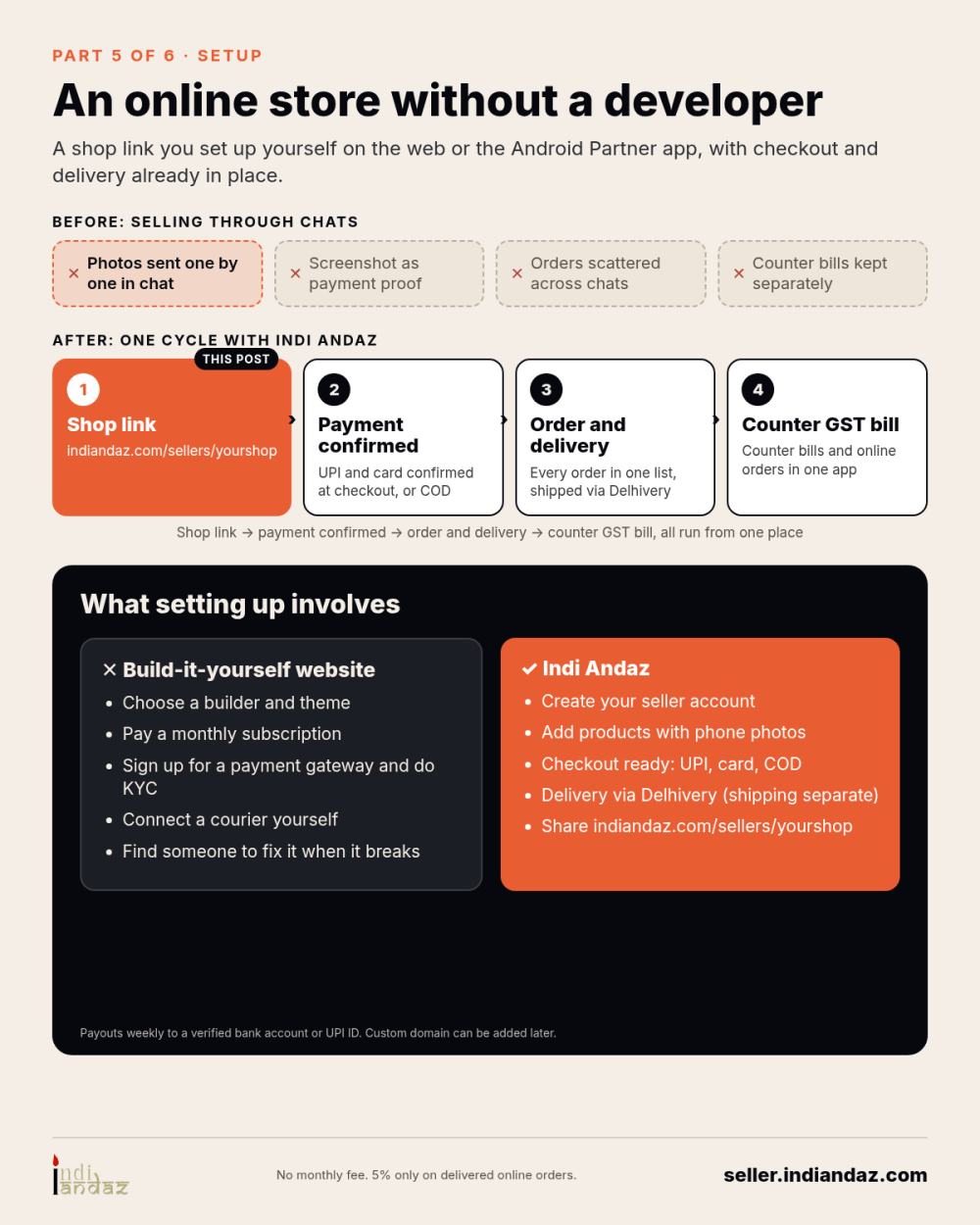
Indi Andaz is built so you can do setup yourself, with no developer, no coding and no website builder to learn. Here’s what it involves:
- Create your seller account on the Seller Portal at seller.indiandaz.com with a 6-digit mobile OTP. After that, the same shop also runs in the Partner app on Android (com.indiandaz.partner).
- Add your products with photos, prices and descriptions.
- Get your store link in the format indiandaz.com/sellers/yourshopname. Share it in your Instagram bio and in chats. You can connect a custom domain later.
- Checkout is ready: UPI, cards and cash on delivery. For UPI and card, payment is confirmed at checkout.
- Delivery goes through Delhivery, charged separately.
- Add a bank account or UPI ID so you can be paid.
If you also bill at a shop counter, read about billing software with an online store.
If you also bill walk-in customers, the Counter app for GST billing (com.indiandaz.counter) handles the shop counter with barcode support. Counter stock and online stock are kept separate today.
Pricing: no monthly fee, 5% only on delivered online orders, payment processing included. GST applies on the fee. On a ₹1,000 product the fee is ₹50, and there’s no separate gateway to set up for UPI or card orders. See how the store link works.
Setup’s only step one. What matters is the full cycle for a shop that sells on WhatsApp and Instagram: shop link, confirmed payment, delivery and GST counter billing, with counter bills and online orders in one app. That closes the three leaks such shops usually have: payment proof you can’t trust, orders lost in chats, and counter bills kept apart from the online side. Our guide to WhatsApp order management for small shops covers the second leak.
What won’t a store link do for you?
- It won’t take your photos. Pictures and descriptions are still your job. They matter most.
- It won’t bring customers by itself. You still share the link on social media and WhatsApp and tell counter customers about it.
- Your link includes indiandaz.com until you connect your own domain.
- COD refusals still happen. The 5% applies only to delivered orders, but shipping is charged separately.
Related reading: sell on Instagram without a website, apni dukan ko online kaise kare (Hinglish), payment gateway in India.
FAQ: selling online without a website
Can I sell online without a website?
Yes. Add your products in the Seller Portal or the Partner app and you get a store link with checkout, no developer needed. You can connect your own domain later if you want one.
Do I need my own payment gateway?
No. Checkout with UPI, card and cash on delivery comes with the store, and the 5% fee on delivered online orders includes payment processing.
How do I sell on Instagram without a website?
Put your store link, like indiandaz.com/sellers/yourshopname, in your Instagram bio and send it in DMs when someone asks for a price. The customer picks the product, types the address and pays at checkout, so the order reaches your list complete. Our guide to selling on Instagram without a website goes further.
New here? Start with our Start here page.
About Indi Andaz Indi Andaz by Prilix Labs gives Indian shops an online store with UPI, card and COD checkout, plus GST billing at the counter. No monthly fee, 5% only on delivered online orders, payment processing included. GST applies on the fee. Based in Ashoknagar Kalyangarh, West Bengal. Start selling
Cover photo: Pew Nguyen / Pexels (stock photo). Inline photos: Lara Jameson / Pexels (stock photo); cottonbro studio / Pexels (stock photo). Infographic: Indi Andaz.


Leave a Reply