
Payment gateway charges in India usually run at about 2% of each successful payment, plus GST on that fee, so roughly ₹23.60 goes on a ₹1,000 order. Most gateways also ask for KYC documents first. From the date NPCI notifies, which NPCI said on 13 Oct 2026 will be immediately after Diwali 2026, UPI payments above ₹2,000 can add 0.4% MDR.
The original 15 Oct 2026 start no longer applies. On 13 Oct 2026, NPCI said the MDR will start “immediately post Diwali at a date to be notified separately” (NPCI statement, 13 Oct 2026). It applies from the date NPCI notifies. Last checked: 28 Oct 2026, no date notified yet.
Picture your family jewellery shop in Surat. (A typical example, not a real shop.) Your son finally sets up an online store for the silver collection. It looks good. Then he tries to take a payment and finds the store can’t take money by itself. He needs a payment gateway.
So begins a week of uploading documents, waiting for verification, pasting API keys and reading about “platform fees” and “MDR”. When the first order finally comes in, you look at the settlement and ask a fair question: “Why is ₹23.60 missing from a ₹1,000 order?”
What is a payment gateway, and why does a store need one?
A payment gateway is the service that takes the customer’s UPI, card or netbanking payment on a website and settles the money into your bank account. Many website platforms and self-built stores don’t include one. You sign up with a gateway company separately and connect it to your store.
That’s a second company, a second contract, a second dashboard and a second set of fees.
What KYC documents does a payment gateway ask for?

Gateways are regulated, so they must verify who you are. Razorpay’s KYC documentation for India is a fair example of what’s typical.
For a proprietorship, it asks for:
- Two proofs of business identity from this list: MSME/Udyam certificate, GST certificate, Shop and Establishment certificate, Import Export Code, or a postpaid mobile bill.
- PAN card of the proprietor.
- Proprietor’s address proof, such as Aadhaar, voter ID or passport.
- Bank account number and IFSC. If bank verification fails, a video of a cancelled cheque.
For individuals and unregistered businesses, it tries to fetch details through CKYC, and asks for PAN and address proof if that fails: Razorpay KYC documents list.
None of this is unreasonable, and plenty of small businesses get through it. But if your shop has no GST certificate or Udyam registration yet, this can be where the online store stalls. If you are getting a GST registration now, our note on GST changes from 1 November covers what the GST Council said about registration steps.
After verification comes integration: installing a plugin or adding code to your store, testing payments, and deciding what happens when a payment fails.
How much are payment gateway charges in India on each order?
Razorpay’s public pricing page is clear about its rates. When we checked it on 6 Oct 2026, it listed a 2% platform fee per successful transaction on domestic payment methods such as UPI, credit cards, debit cards and netbanking, plus GST on that fee, with no setup fee and no annual maintenance charge: Razorpay pricing.
On a ₹1,000 order, with GST on the fee at 18%, that works out to:
- Platform fee: ₹20
- GST on the fee (18%): ₹3.60
- Total: ₹23.60, deducted before the money reaches you. The rest lands in your bank account on your settlement cycle, which Razorpay’s page puts at typically T+1 or instant.
That’s where your son’s missing ₹23.60 went.
Isn’t UPI supposed to be zero cost?
Not through a gateway. The UPI rules for merchants change from the date NPCI notifies, announced to follow Diwali 2026. The rules are explained in UPI MDR charges for small shops.
MDR, or merchant discount rate, is the fee a shop pays its bank for accepting a digital payment. Right now, UPI transactions from a bank account carry zero MDR, and Razorpay’s pricing page says so too. The same page shows its 2% platform fee still applies to regular UPI payments made through it, and calls that 2% a platform or technology fee, not MDR.
What changes for UPI merchant fees after Diwali 2026?
On 15 Sep 2026, the Ministry of Finance and NPCI announced a new MDR framework for UPI payments to merchants. It has been announced but isn’t in force yet. It was due on 15 Oct 2026. NPCI then said it will start immediately after Diwali 2026, from a date it will notify. Under the framework announced on 15 Sep:
- UPI payments to a merchant of ₹2,000 or less: zero MDR. A Finance Ministry gazette notification of 14 Sep 2026 bars banks and payment system providers from charging for these, and for payments with RuPay debit cards of any amount.
- UPI payments to a merchant above ₹2,000: 0.4% MDR, paid by the merchant, capped at ₹300 for payments of ₹75,000 and above. On a ₹3,000 payment that’s ₹12.
- Railways, telecom, insurance, fuel and some other sectors: a flat ₹5 per payment above ₹2,000 instead of 0.4%.
- Small merchants in the P2PM category (UPI QR payments of up to ₹1 lakh a month into their own account): zero MDR on all payments. A merchant that receives more than ₹1 lakh a month for three months in a row moves to the regular merchant category.
- Customers and person-to-person transfers: no charge. Merchants may not add the MDR to the customer’s bill.
Sources: the PIB release of 15 Sep 2026 and the Department of Financial Services FAQ on UPI MDR, dated 15 Sep 2026.
What does this mean for gateway payments?
The ₹1,000 order in our example is under ₹2,000, so nothing changes for it. Under the framework announced on 15 Sep, UPI payments above ₹2,000 will carry a 0.4% MDR once it starts. Tax experts quoted in news reports (News18, 17 Sep 2026) say 18% GST applies on that MDR fee; we have not seen this in an NPCI or CBIC document, so confirm with your CA. When we checked on 6 Oct 2026, Razorpay’s pricing page didn’t show an MDR line yet, so ask your gateway how it will show on your settlements.
When a customer scans your shop QR and pays you directly, there’s no gateway fee. Before the date NPCI notifies, there’s no MDR either. From that date, payments above ₹2,000 carry 0.4% MDR unless your shop is in the P2PM small merchant category.
What does the full fee stack look like for a small shop?
The gateway’s cut is one layer of several, and the total cost is what matters. A typical self-built setup stacks up like this:
- The store platform subscription, every month. Shopify’s India page, for example, lists Basic at ₹1,994 a month paid monthly (checked 6 Oct 2026), and says third-party transaction fees may apply if you use a third-party payment provider instead of Shopify Payments (Shopify India pricing).
- The gateway fee on each payment, plus GST on it.
- Shipping, through whichever courier you set up.
- Your time for KYC, integration and matching settlements to orders.
To compare these fees with a platform cut, see ecommerce platform commission vs monthly fee.
Each layer is fair on its own, and none of them are hidden charges if you read the pricing pages. Together, for a shop doing a handful of online orders a week, they add up to a lot of fixed cost and paperwork before the first sale. Our guide to ecommerce website cost in India walks through the whole stack and shows how to compare a monthly plan with a per-order fee using your own numbers.
When does a separate gateway make sense?
Sometimes it does. Be fair to it.
If you already run a website with healthy, steady online volume, a 2% gateway fee can cost you less per order than an all-in percentage. Larger businesses can also negotiate custom pricing with gateways. Before you sign with one, our checklist to compare payment gateway quotes lists what to ask each gateway.
The sums change if you sell mainly through Instagram and WhatsApp, have quiet months, and don’t want to manage a website, a gateway contract and courier accounts separately. COD vs prepaid covers when cash on delivery is worth offering.
Payment processing is also one piece of a bigger cycle. A shop selling on WhatsApp and Instagram loses money in three places: payment proof it can’t trust, orders lost in chats, and counter bills kept apart from online orders. A payment setup should help with the first, not add a new job. If screenshots are your headache, read how to identify fake UPI payment before you ship.
How does Indi Andaz handle payments without a separate gateway?
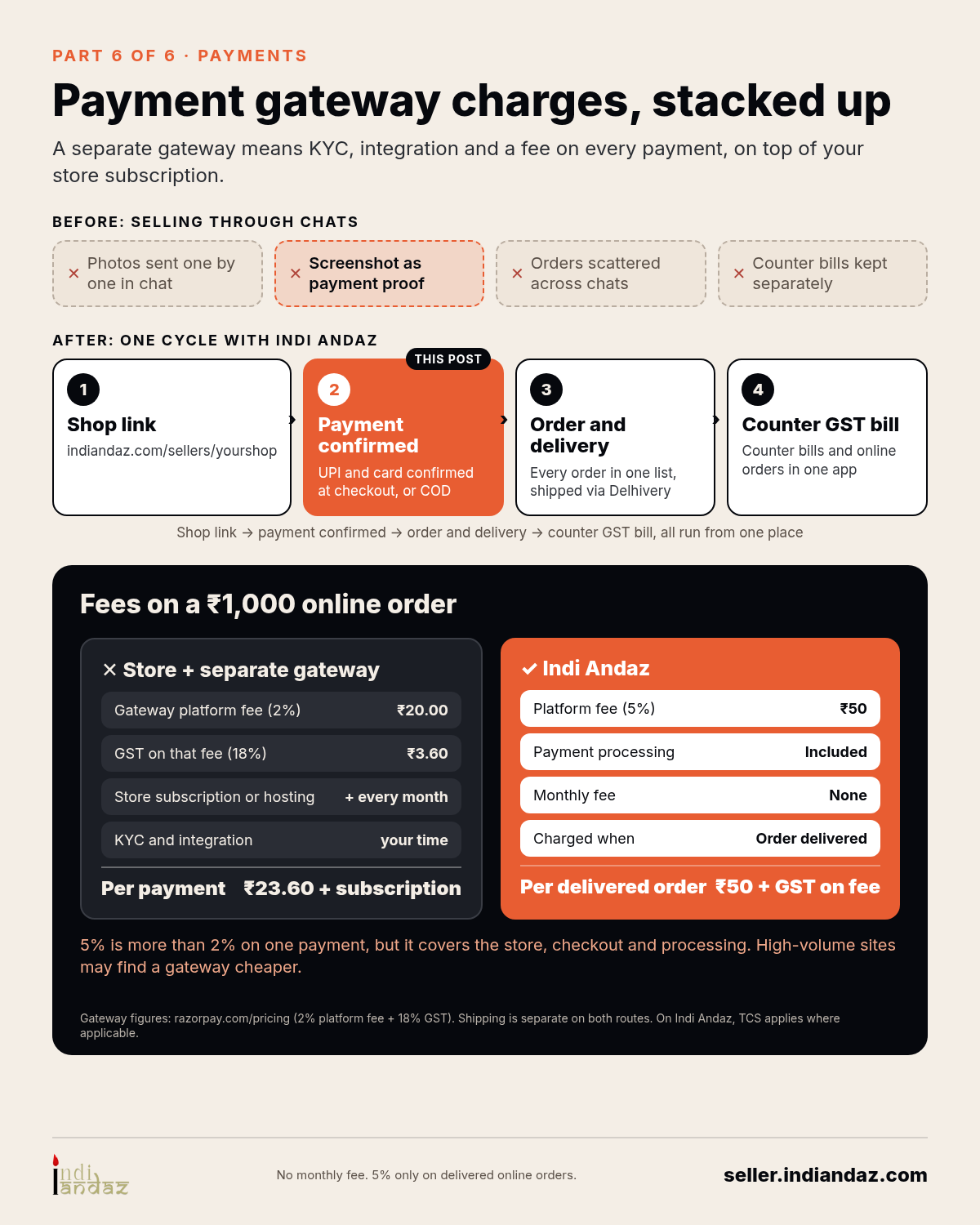
With Indi Andaz, checkout comes with your online store. There’s no gateway to sign up for and nothing to integrate. Hindi me padhna ho to dukan me online payment kaise kare dekhiye.
- Your store link, like indiandaz.com/sellers/yourshopname, opens a checkout with UPI, cards and cash on delivery.
- Payment is confirmed at checkout for UPI and card, so orders arrive marked paid in the Seller Portal and the Partner app.
- One fee covers it: no monthly fee, 5% only on delivered online orders, payment processing included. GST applies on the fee. You pay no separate payment gateway fee for UPI or card orders.
- UPI fee after Diwali 2026. Under the framework announced on 15 Sep, from the date NPCI notifies, UPI payments to merchants above ₹2,000 carry a 0.4% fee (MDR), capped at ₹300 per transaction (the cap applies at ₹75,000 and above). On Indi Andaz it’s covered inside the 5%, so your fee doesn’t change.
- Example: a customer pays ₹1,000, the platform fee is ₹50. GST applies on the fee.
- No monthly fee, so a quiet month with few orders costs you little.
- Shipping via Delhivery is charged separately. It isn’t part of the 5%.
At the counter, the Counter app handles GST billing with cash, UPI, card, udhar or split payments, so counter bills and online orders sit in one app. Counter stock and online stock are kept separate today.
What are the honest limits?
- 5% is more than 2% on a single payment. You’re paying for the store, checkout and payment processing together, with no monthly fee. Compare the full stack, not one line.
- You still need a verified bank account or UPI ID for payouts.
- Cash on delivery isn’t prepaid. Refusals still happen. The 5% applies only to delivered orders, but shipping is charged separately.
- GST applies on the fee.
Related reading: UPI MDR after Diwali 2026, UPI MDR kya hai, COD vs prepaid for small shops.
FAQ: payment gateway charges
How to avoid payment gateway charges?
On a direct QR payment at your counter there’s no gateway fee. Online, some fee always applies, so the question is who bundles it. On Indi Andaz, the 5% on delivered online orders includes payment processing, so you don’t sign up for or pay a separate gateway.
How much does a payment gateway charge in India?
On 6 Oct 2026, Razorpay’s public pricing listed 2% per successful domestic transaction plus GST on the fee. At 18% GST, that’s ₹23.60 on a ₹1,000 payment.
Does UPI have transaction charges for merchants now?
Under the framework announced on 15 Sep, once the fee starts after Diwali, UPI payments to a merchant above ₹2,000 will carry 0.4% MDR, capped at ₹300 per transaction (the cap applies at ₹75,000 and above), paid by the merchant. Payments of ₹2,000 or less, person-to-person transfers and small merchants in the P2PM category (up to ₹1 lakh a month through UPI QR) stay at zero MDR. It applies from the date NPCI notifies, announced to follow Diwali 2026 (last checked 28 Oct 2026, not yet notified). A gateway’s own fee, such as Razorpay’s 2%, is charged separately.
How much does Razorpay charge per transaction on UPI?
Its pricing page lists zero MDR on regular bank-to-bank UPI, but its 2% platform fee plus GST still applies (checked 6 Oct 2026). With high, steady volume on your own website, a gateway may still cost you less than an all-in 5%.
New here? Start with our Start here page.
About Indi Andaz Indi Andaz by Prilix Labs gives Indian shops an online store with UPI, card and COD checkout, plus GST billing at the counter. No monthly fee, 5% only on delivered online orders, payment processing included. GST applies on the fee. Based in Ashoknagar Kalyangarh, West Bengal. Start selling
Cover photo: Anna Shvets / Pexels (stock photo). Inline photo: Tima Miroshnichenko / Pexels (stock photo). Infographic: Indi Andaz.


Leave a Reply